Christological Controversy (Sources of Early Christian Thought) by Richard A. Norris
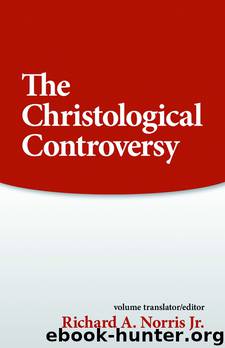
Author:Richard A. Norris [Norris, Richard A.]
Language: eng
Format: azw3
ISBN: 9781451416749
Publisher: Fortress Press
Published: 1980-08-01T04:00:00+00:00
7
Apollinaris of Laodicea
ON THE UNION IN CHRIST OF THE BODY WITH THE GODHEAD
(1) Rightly is the Lord confessed to have been a child who was holy from the beginning, even in what concerns his body. And in this regard he differs from every other body, for he was conceived in his mother not in separation from the Godhead but in union with it, just as the angel says, “The holy Spirit shall come upon you, and the power of the Most High shall overshadow you, so that your holy offspring will be called Son of God” [Luke 1:35]. Moreover, there was a heavenly descent, not merely a birth from a woman; it is said not only “Born of a woman, born under the Law” [Gal. 4:4] but also “No one shall ascend into heaven, save he who came down from heaven, the Son of man” [John 3:13]. (2) And it is not possible to take the body separately and call it a creature, since it is altogether inseparable from him whose body it is. Rather, it shares in the title of the uncreated and in the name of God, because it is conjoined into unity with God, just as it is said that “the Word became flesh” [John 1:14] and, by the apostle, “The last Adam became a life-giving Spirit” [1 Cor. 15:45].
(3) Just as we attribute glory to the body by reason of the divine conjunction and its unity with God, so we ought not to deny the inglorious attributes that stem from the body. These are, in the words of the apostle, “to be born of a woman” [Gal. 4:4] and, in the words of the prophet, “to have been formed from the womb as a slave to God” [Isa. 49:5], really to be named “human being” and “Son of man” and to be reckoned later than Abraham by the many generations after which he became man. (4) Indeed, it is necessary to speak and to hear [of him] in human terms, even as, when he is called truly a human being, no one will deny the divine essence which, together with the body, that title signifies; and when he is called a slave by reason of his body, no one will deny the royal nature which, together with the body, is signified by name of slavery; and again, when a heavenly man is said to have descended from heaven, no one will deny that the earthly body is knit together with the Godhead. He is not divided either in fact or in name when, by reason of his conjunction with the form of a slave and with the created body, the Lord is called a slave, and the uncreated is styled “made.”
(5) The confession is that in him the creature is in unity with the uncreated, while the uncreated is commingled with the creature, so that one nature is constituted out of the parts severally, and the Word contributes a special energy to the whole together with the divine perfection.
Download
This site does not store any files on its server. We only index and link to content provided by other sites. Please contact the content providers to delete copyright contents if any and email us, we'll remove relevant links or contents immediately.
The Secret Power of Speaking God's Word by Joyce Meyer(3165)
Signature in the Cell: DNA and the Evidence for Intelligent Design by Stephen C. Meyer(3123)
Real Sex by Lauren F. Winner(3006)
The Holy Spirit by Billy Graham(2941)
The Gnostic Gospels by Pagels Elaine(2522)
Jesus by Paul Johnson(2351)
Devil, The by Almond Philip C(2324)
23:27 by H. L. Roberts(2245)
The Nativity by Geza Vermes(2226)
Chosen by God by R. C. Sproul(2159)
All Things New by John Eldredge(2156)
Angels of God: The Bible, the Church and the Heavenly Hosts by Mike Aquilina(1952)
The Return of the Gods by Erich von Daniken(1927)
Angels by Billy Graham(1920)
Knowing God by J.I. Packer(1850)
Jesus of Nazareth by Joseph Ratzinger(1802)
The Gnostic Gospel of St. Thomas by Tau Malachi(1781)
Evidence of the Afterlife by Jeffrey Long(1776)
How To Be Born Again by Billy Graham(1775)
